Monday, April 4, 2016

A Vacation with Tour Groups or with Friends


You can be on vacation in the same country, but you'll have completely different experiences with tour groups versus just traveling with friends.

Tour Groups: 
When you hear this word, you immediately think of large buses where once the doors open, the tourists pour out. In NYC, you have to watch out for these buses or you'll get run over.
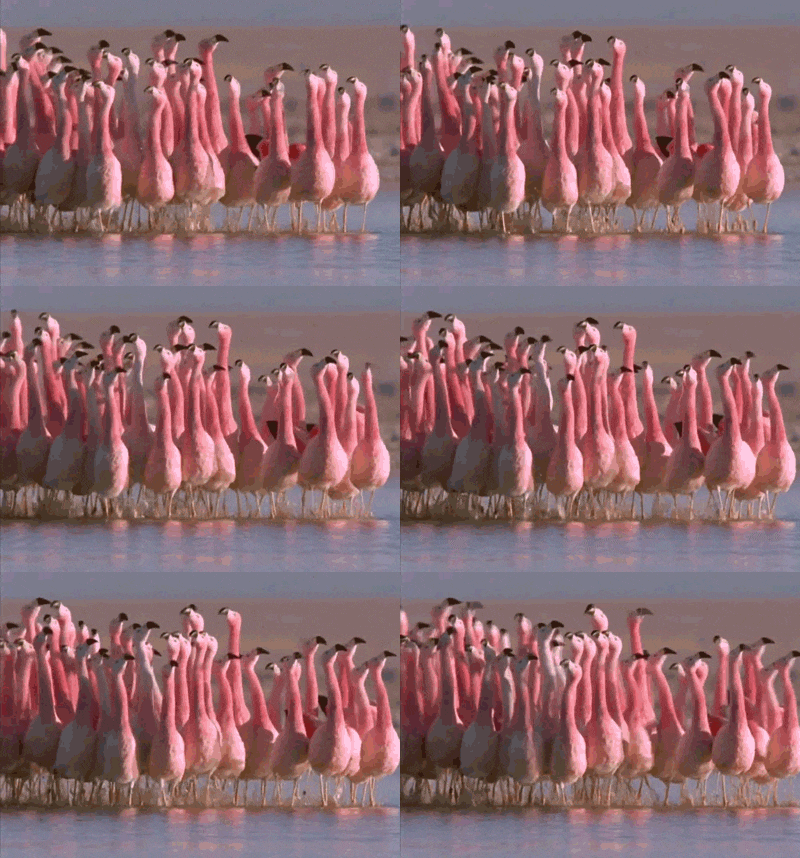
pink flamingo

However, tour groups aren't always like this. You can find tour groups of any size or theme to fit what you want. When Mom and I were on vacation in Ireland, we were in a tour group of about 30 people. We chose this option because we wanted to explore the island, but Mom didn't want to drive on the left-hand side of the road (I was grateful for that decision!). We could've gotten around by buses, but we also didn't know much about Ireland, whereas when we went to France we already had ideas of what we wanted to see. We also wanted a smaller tour group to make some meaningful relationships.

Pro's:
  • You'll never get lost
  • You'll see the popular touristy sites
  • You get to cut ahead of lines at museums or sites
  • You don't have to do any planning = no stress
  • You'll make some fun friendships with the people in your group 
  • You're not alone - you will be surrounded by others who know your culture or language (this can be comforting)

Con's:
  • You are not in charge of your time - you don't get to choose if you want to stay longer at a site
  • You only see glimpses of the country - you don't get to dive deep in a certain town or activity 
  • The people on the group can be annoying
  • You usually only go to touristy sites - you don't get to see those special or unique sites that you could see by yourself
Traveling with Friends or Family: 
I've traveled with friends where one of them was an expert of the country, and this was awesome because they took us to the local spots that we wouldn't have found by ourselves. This is my personal preference while traveling. However, I've also done vacations where none of us knew anything about the country. This can lead to some really funny stories. 

Pro's: 
  • You'll see or experience things you wouldn't see with tour groups
  • You'll see and experience more of the real culture - you'll eat at real, local spots 
  • You're in charge of what you want to see/do (this can be very liberating and also stressful)
Con's: 
  • This can be stressful and may lead to more tension with your travel buddies 
  • You will get lost (I find this to be fun but some people wouldn't agree with this)
  • You might not get all the history or knowledge of a site that a tour group leader would provide
***You can get the best of both worlds by traveling with family and friends, and doing day trips with tour groups to certain sites/locations. Mom and I did a one day tour group to Giverny. Our guide showed us the important sites and told us the history, and at the end of the day we were on our own again. 


Wednesday, March 30, 2016

My Favorite Suitcase for Traveling

I've had this bag since my first international trip (summer of 2013), and it's one of the best bags I have ever owned. My mom was so kind enough to buy me this suitcase, and she got it from the Rick Steves' Travel Site. If you don't know Rick Steves, he is a travel guro. He has tons of travel books that are super helpful, as well as tons of resources on his website for planning a trip. Well, he also sells suitcases, and they're amazing.

Rick Steves' Rolling Carry-On Suitcase

Dimensions: 21" x 13.5" x 9" (including wheels)
Weight: 6.65 lbs
Capacity: 2430 cubic inches (2970 expanded)
Materials: Polyester fabric with molded shell frame

Cost: $160

Positives: 

  • Lightweight bag (only 6 lbs by itself) that allows for easy lifting and maneuvering  
  • Small enough bag so it fits in overhead bins, even the smaller ones on Europeans flights
  • Expansion capability where you gain 2 additional inches of cargo depth - my favorite feature that I use all the time, although the bag will have to be checked
  • Durable wheels that have handled all different kinds of pavement (including NYC's harsh sidewalks)
  • Soooo many pockets - two deep pockets on the outside and a mesh pocket on the inside
  • It's a different looking bag, depending on the color you choose, so it's easy to spot
  • The bag has a shell that gives it shape, but at the same time it's very flexible so I can always stuff a ton into it
  • Amazing quality and I haven't had any rips or zipper problems
Negatives: 
  • The expansion capability makes the bag fatter, so it generally tips over if you aren't holding on to it
  • Sometimes it can be too small (this generally means I'm overpacking then)
  • A bit expensive

If I had to rate the bag from a 1 to a 5, I would easily give it a 5. Although the bag is generally mean for carry-on, I have rarely used it for that. A smaller bag is what you're going to want while traveling internationally because it'll be lighter and easier for you to carry it around a ton if need be. The expansion capability will also make it easy if you buy a lot of souvenirs and need a little extra room in your bag (this is what I always do). It is a bit pricey but it's totally worth it. 


For more info: https://store.ricksteves.com/shop/p/rolling-carry-on


Travel Advice for the Tired, Frustrated Travel Companion

When traveling with friends or family, you will get on each others nerves, so here is some
travel advice on how to manage emotions when they're running high. 

This is travel advice that my mom and I learned the hard way, but it's one of my favorite memories with her. We were in Paris, and after several days of running around we were pretty tired. That morning we were heading to the Musee d'Orsay (a museum I strongly recommend), and we were for some reason (I can't remember now) arguing. When we got to the museum, we both wanted space away from each other, so we split up. We both didn't think the museum was that large compared to the Louvre, but there are multiple levels and we soon lost each other. I searched high and low for her in the museum, but I couldn't find her. We also had tickets for an activity that afternoon, and neither of us wanted to miss that. So I had to decide whether to stay at the museum and keep looking for her, or head back to the hotel where the tour starts, and hope that she heads there too.

I decided to head back to the hotel, but then I had to figure out how to get back. Thankfully, I had paid attention on our way to the museum, so I easily found where we had made turns, but we had also taken the Paris metro system, and I didn't have a clue as to which line I needed to take to get to my final destination. This was before moving to NYC where I would become a pro at reading metro maps. So I stood around and waited until I saw a person that I deemed trustworthy, and I asked him for directions. He led me to the train I needed to take. I finally got back to the hotel room, and lo and behold my mom was waiting for me. She was so worried about me, and she was hoping that I would head back to the hotel as well. We laughed over the morning events and we were back in each other's good graces again. However, we always planned where we would rendezvous if that happened again, which is another good tidbit of travel advice. 

The moral of the story is you will get mad or frustrated with your travel companions; it's only natural when you're around each other 24/7. However, be patient with each other and give your friend or family member the benefit of the doubt. Don't be quick to get frustrated or get upset over everything. And when you do get mad, then talk about what's going on with your travel buddy. However, do it in a place where you won't stomp off and then get lost. That's travel advice my mom and I learned and don't wish to repeat.


Thursday, March 24, 2016

Capturing the Moment by Yourself

"Strap that camera to your arm, otherwise someone will grab it and it'll be gone."

This was my piece of advice from my Cambodian friend while I was visiting her country. We were riding a tuk-tuk, also known as a rickshaw, and I wanted to take some pictures along the ride. However, I was told that I would need to have the camera strap wrapped around my arm because it could fall (it is not an enclosed ride) or someone could grab it as they drove by our taxi. There are no enforced traffic laws in Cambodia, so there are no lanes that people stay in, so someone could easily have grabbed if if I wasn't paying attention. So just be aware of where your camera and phone is, and you'll be good!

A quick clip of some Cambodian traffic

However, I'd also like to say that it's not necessary to always take photos or videos. We all want to get pictures/videos of our travels to show to our friends and family, but don't forget to experience where you are. This sometimes means you need to put down the camera. I still remember when I was on a trip with my mom in middle school and all I wanted to see was some dolphins. When I did see some, I was so caught up in trying to catch them on film that I didn't really get to see or watch them, and they were only there for half a minute. So basically I didn't really "see" the dolphins.

Some of my best memories while I've travelled have been when I didn't have my camera with me. We all want to capture this moment or this thing that amazes our eyes, but what we should be asking ourselves is, "What about this moment or site do I love?" Sometimes there is something about it that film can't always capture. I'm not saying never take photos or videos because they are a lot of fun to look back on, but don't forget to really be there in that moment and take in with your own eyes what you're seeing. By doing so, you'll appreciate it even more and it'll be left up to your memory to remember.

Hide the Benjamin

Hopefully you got it in the title, but if you didn't, then I'll just let you know that you'll be carrying a lot of cash with you when you're traveling internationally. So don't lose it!

cat money cash

1. Do not carry all of your money on you: Carry some of the cash in your purse/wallet and put the rest in a hotel safe. I generally like to split it up into three piles. I have two wallets in my purse with one of them being my emergency one just in case the other gets lost. I then put the rest in the hotel safe. Some people use a money belt, which is something that is attached around your neck or waist and underneath your clothes. I personally don't like using them because I think they looks obvious and they're uncomfortable, but I know some people who really like it.

2. Do not take out a huge wad of cash while you're paying for something: You become a target when you're showing a lot of cash and being totally obvious about it. When you pay for something, only pull out one bill.

3. Have small bills: It's fine for you to carry large bills around, but some places I've been to don't like breaking the big bills. If you're having a hard time with that, I would recommend trying your luck in a touristy location.

4. Don't forget to use the coins: This goes especially in Europe because there are no paper euros below $5. They have 1 and 2 dollar coins that they love to use, and your bag might be heavier with all the coins you're carrying around but forget to use. Don't forget to pay with coins first because if you want to exchange your money back into your currency, coins are generally not accepted.


Passports 101

"On the black market, your passports can be sold for around $10,000"

This is what I was told when preparing for my school trip to Turkey. Our team was going through these dramatized simulations at a retreat to learn how to be safe and know what to do in certain situations. One of the lessons they kept drilling into us was to be super aware of where our passports were at all times. To learn this lesson, we had to "check in" to this "customs agent" (a.k.a our trip leader) to get into the "country" (a.k.a our cabin for the weekend). When each person was approved they could then go to the security section (a.k.a some students ruffling through bags). However, if the student did not ask for their passport back, then the custom agent would keep it. So many of the students were distracted that they didn't even notice they had left without their passport. Thankfully I wasn't one of them.                        


After this simulation we all got together to discuss logistics and what problems people needed to prepare themselves for the next time. Now, this simulation with the passports was very exaggerated, and will most likely never happen. However, it is important to be this aware of your passport at all times. Here are some tips:

1. Photocopy your passport: Do this before the trip and have these copies (best if they're color copies) with you in the country. That way if your passports gets stolen or lost, you will have the copy to prove who you are. It'd be even better if you left one of the colored copies with your family members or friends back home, so if all else fails, they can send the copied document.

2. Carry or hide your passport: If you carry it on you, then keep it close at hand in a money belt or a zipped up pocked in your purse. You can also hide your passport in the hotel safe or your bags if you have locks for them.

Do Not Lose These Items

Let's face it, you're going to misplace something or its going to get snitched, and that's just the reality of travel. But when it comes to international traveling, do not let these items out of your sight!

1. Passport: This is your most important document! I generally carry it in a pocket in my purse that has a zipper so no one can reach in and easily grab it, but I'll also leave it in the hotel safe that's in my room. I know some people who carry it in a money belt, so whatever works for you, but be very aware of where you put it. To read more about Passports 101 click here.

2. Money: Don't keep your money all together in a nice envelope because if that gets stolen, then there goes all your money. In fact my mom told me this happened to one of the persons in her tour group, and it was on the first day of the trip! Split up your cash into different piles. Carry one of the piles with you in your purse, and hide the other piles in various locations like your hotel safe, your money belt, or deep in your suitcase (that hopefully is locked when you're out of the room). To read more about traveling with money click here.

3. Camera: If this gets stolen/lost, it's not the end of the world (unless your camera is also your phone), but this is another common item that gets stolen/lost. Just never leave your camera/phone out in the open. Whenever I'm not using one of these items, they are put away in my purse. Sometime we don't need our camera, and to read more click here. 

I have never lost or had stolen any of these items, but it's because I am hyperaware of where I place these items (more so than when I'm back at home). And if you do the same thing, then you should not have a problem.